Years on, the same question
When Fiöi dal Nos was presented, in 2015, El Brenz was a young association and this documentary was its first great act: to set out, with rigour and with passion, the evidence of an ancient identity. Eleven years have passed, and those questions are still our compass. In the meantime the research that underpins it has not lost a comma of its validity, and the voice of those interviewed keeps speaking. That is why we wanted to give it back the place of honour it deserves.
The motivation
At the root lies an aim at once simple and ambitious: the rediscovery of the ancient historical, cultural and linguistic roots of the Valli del Noce. Not an exercise in nostalgia, but the will to give a foundation to what our elders always knew by instinct, that the nosa parlada (our speech) is not a lesser “dialect”, but a language with a long and noble history.
The journey of the research
The study behind the documentary spans two thousand years: it starts from the Rhaetians and the Fritzens-Sanzeno culture, continues with the Romans and the slow shift from Rhaetian to Rhaeto-Romance, up to the definition of the Ladins, the cartographic evidence and the chronology of the scholars who, from Ascoli onward, have recognised the Ladin identity of our valleys. Its emotional heart is the field research of Massimo Paternoster. What follows is the study in full.
The importance of history
The research on which the documentary is based.
The Rhaetians
Around 500 BC the Fritzens-Sanzeno culture appears in Trentino-Alto Adige, the Lower Engadine and Vorarlberg, taking its name from two places set, respectively, in the Inn Valley in Austria and in the Val di Non in Trentino. This culture arises from the development of the earlier Luco culture enriched with elements from the Po plain. Its spread across a well-defined geographical area is shown by the presence of particular types of pottery, iron tools (axes, hoes, keys) as well as ornamental bronze objects. In the same area one also finds the same dwellings, cult practices and inscriptions, made with the characters of the alphabet of Bolzano or of Sanzeno, corresponding to a variant of the North Etruscan one, adapted to the needs of the local language. The Fritzens-Sanzeno culture is held to be proper to the Rhaetian population because there is a correspondence between a broad part of the area assigned to those peoples by the ancient sources and the territory that archaeological research has shown to have been marked by this culture.
Strabo (63 BC – AD 19), for example, wrote that the population of the Rhaetians occupied the central-eastern Alpine area, beyond Como and Verona, as far as the lands crossed by the Rhine and Lake Constance. It is precisely in this zone that archaeological discoveries have brought to light dwellings and objects of the same characteristics, so much so as to consider them distinctive elements of a single culture, namely that of Fritzens-Sanzeno.
The most characteristic object of Rhaetian culture is a ceramic cup with an omphalos base and an “S”-shaped profile. The Rhaetians left numerous proofs of their presence in Trentino, not only in the main valleys but also in the inner ones. It has been possible to find the remains of true villages, built on heights (Fai della Paganella, Dos Castel locality; Castel Tesino), on terracing (Montesei di Serso, Sanzeno), on the valley floor (Nomi, Bersaglio locality), by alluvial fans (Zambana). The settlements consisted of semi-underground, quadrangular houses, bordered by dry-stone walls and often provided with an access corridor. The walls and roof of the dwellings must have been made of wood or straw, perishable and easily flammable materials, as the traces of frequent fires show.
The economy of the Rhaetian peoples was rather varied. Besides hunting, evidence has been found of pastoral activity and the raising of sheep and goats, oxen, horses and poultry. Many billhooks have also been found, a tool that made more productive the intensive gathering of tree foliage to be stored as winter fodder for the animals. There was also active farming, as the remains of wheat, barley and lentil seeds found during excavations demonstrate. Wine production is also widely attested, through the presence of grape pips, bronze vessels meant to hold it, work tools, implements for building barrels, and figured scenes appearing on the situlae, small buckets of very thin bronze sheet, decorated on the outside with the repoussé technique or with the burin. The habit of decorating situlae spreads between the 7th and 4th centuries BC across an area reaching from the Po to the Danube and gives rise to a true “art of the situlae”, which probably originates from the Etruscan world, with which the Rhaetians certainly had many contacts.
The Rhaetians attached great importance to the sacred sphere, as shown by finds referable to sacred areas and votive pyres: true ex-votos, mostly figured bronze statuettes bearing dedications to the deities at Sanzeno, engraved pebbles at Montesei di Serso, bones with inscriptions or cut bronze sheets at Mechel. At this last site, frequented from the Late Bronze Age until the Roman era (3rd/4th c. AD), miniature fibulae, deer antlers with inscriptions and fragments of figured situlae were often brought as offerings. At Stenico, in the Calfieri locality, traces have been found of a place of worship already frequented in the Middle Bronze Age, with votive pyres. In this period the funerary rite of cremation was practised.
The Rhaetians were a people native to the central-eastern Alpine area: skilled craftsmen (the Second Iron Age practically coincides with their culture) and peaceful mountain folk, who came down as far as the Veronese plain to barter goods and livestock. They had contacts with the Etruscans, from whom they learned the alphabet, and with the Celts, but ethnically they are to be considered Alpine natives. The elements of continuity between the culture of the Rhaetians and our own are to be sought above all in the relationship with the environment, with the cultivated spaces and with the mountain, where the Rhaetians led their livestock to the high pastures. Also in the mountains they carried out spectacular cremations and votive pyres (with sacrifices of animals and vessels) that recall the fires still lit today on the peaks, in Alto Adige. Pastures, fields and mountains were held in common; the communities gathered in assemblies to deal with their affairs and to elect the tribal chiefs, principles that would later be absorbed by the Carte di Regola of the free Trentine communes. But it is perhaps in building that the most surprising analogies are found: the siting of the ancient Rhaetian villages, the orientation and form of the houses (quadrangular, single-family modules, with rooms in a row) recall those of many modern mountain hamlets.
Another cultural element that Trentino has fully inherited is its twofold orientation toward the Danubian pole and the Po one: between the land of the Teutons and that of the lemons. To Cato the Elder we owe the first mention of the term “Rhaetian”, used to identify a much-prized wine. The limits of the area assigned to these peoples, however, escape any detailed identification: the news handed down by the Greek and Roman sources is scanty, incidental and at times contradictory. On the basis of what Strabo and Pliny the Elder in particular report, it is nonetheless possible to circumscribe the territory of the Rhaetians within the central-eastern Alpine area. The considerable difference between the archaeological evidence of the Etruscan and of the Alpine territory, and the recognition in the latter of specific cultural aspects with phenomena of continuity, clearly rule out a descent of the Rhaetians from the Etruscans, despite the strong influence of the latter. Rome’s expansionist policy at the expense of the Alpine peoples was crowned in 16-15 BC with the Rhaetian Wars, waged victoriously by Tiberius and Drusus, the adopted sons of Augustus.
Bibliographic references: Franco Marzatico, entry “Reti” in the Enciclopedia Archeologica, Istituto dell’Enciclopedia Italiana Treccani; works of Strabo, Pliny the Elder, Pompeius Trogus, Livy, Cassius Dio Cocceianus.
Writing and language
One of the most important achievements in the cultural history of the Rhaetians is the appearance of writing around 500 BC. It spread among the Veneti and in the Alps through the mediation of the Etruscans and was used above all for worship, for votive inscriptions in the sanctuaries and on funerary stelae. Most of the surviving inscriptions consist of a few alphabetic signs: this confirms that only the smallest part of the population, above all the priests, knew how to write and read. On the basis of about 300 inscriptions in the sinistrorse “North Etruscan” alphabet found in Rhaetian territory, four graphic variants are distinguished: the alphabet of Lugano, of Sondrio-Valcamonica, of Bolzano (or of Sanzeno) and of Magrè, the latter two of non-Indo-European origin. The presence of these different alphabets reveals the existence of various languages and dialects.
Rhaetian museums
Museo Retico, Centre for the Archaeology and Ancient History of the Val di Non. It presents itself as an active hub of cultural communication and a tool for enhancing the ancient history of the territory. The building, of deconstructivist stamp, designed by the Trentine architect Sergio Giovanazzi, houses the permanent display of the rich local archaeological heritage, with halls for videos and conferences, spaces for temporary exhibitions, teaching workshops, the section of the “Pia Laviosa Zambotti” archaeological library of Trento and a vast outdoor area for experimental archaeology. Inside, the exhibition “Sanzeno Antica” can also be visited, illustrating the history of archaeological research from the 19th century to today. The building stands at the start of the walk that leads into the gorge of the San Romedio sanctuary. The exhibition route accompanies the visitor from prehistory to the early Middle Ages, with an important role reserved for the Rhaetian people; the layout is by the Turin architect Maurizio Buffa. (visitvaldinon.it, Museo Retico)
Rhaetian Museum of Chur (Switzerland). The history museum of the Grisons stands in the Buol House, in the old town of Chur: a Baroque patrician house built in 1675 by Baron Paul von Buol of Strassberg and Rietberg (1634-1697). As in other Swiss cantons, the museum was founded toward the end of the 19th century to check the growing exodus of precious cultural goods, at the initiative of the jurist, historian and politician Peter Conradin von Planta-Zuoz (1815-1902). On 8 June 1872 it was inaugurated on the ground floor of the Buol House. (raetischesmuseum.gr.ch)
The Romans
Trentino is a territory frequented by humans in an essentially continuous way since the most ancient ages, from the Palaeolithic to the Roman era. The region lies in a geographical position that creates a link between the Po area and the territories north of the Alps: the Val Venosta (Vinschgau), with the Resia pass, favoured contacts with the Engadine and south-western Germany, while the Val Pusteria (Pustertal), with the Brenner pass, favoured those with the eastern Alpine area. The presence of Lake Garda eased communications with the Po plain; the Adige, which crosses the region lengthwise, and the many transverse valleys have always allowed easy cultural exchanges, even with distant lands (think of the columbella and cyclope shells of the Riparo Dalmeri, or the obsidian from Lipari found at La Vela). To an economy based at first on hunting and gathering were added, from the Neolithic, animal husbandry and agriculture; viticulture, from the Iron Age, was practised above all in southern Trentino, and various Roman authors (Florus, Suetonius, Pliny) speak of the famous “Rhaetian wine”.
In the passage between the second Iron Age and the Roman era the local culture was not entirely supplanted by the Roman one, but often kept its originality: in the everyday iron objects, in the habit of placing initials in the Rhaetian alphabet on loom weights, in burying the dead dressed as in life. The archaeological data support the idea that from the 2nd/1st c. BC there were no major military episodes in Trentino and that relations with the Romans were fairly peaceful. The first contacts go back to the 3rd/2nd c. BC and took place, save in rare cases, not by force but through peaceful trade and treaties with the local ruling classes. Only at the start of the 1st c. BC did the region north of the Po (Transpadana or Cisalpina) receive a comprehensive political and administrative organisation, with the granting (probably in 89 BC) of the ius Latii; in 49-42 BC the Cisalpines obtained Roman citizenship. Thus arose the Municipia, formed of a town and its surrounding territory, governed by four magistrates.
From Rhaetian to Rhaeto-Romance through Vulgar Latin
Definition of Rhaeto-Romance. Said of the set of Neo-Latin languages and dialects established in the area once occupied by the ancient Rhaetians. This peripheral linguistic zone of Romance-speaking Europe has, over the centuries, been much eroded, reduced and fragmented: of it there survive today the three Neo-Latin dialect groups of the central-eastern Alpine and sub-Alpine zone, the speech of the Grisons, of Friuli and of some Dolomite valleys, known as Ladin dialects.
Ladin consciousness. In the 19th century a widespread Ladin national consciousness arises, together with the conviction that Ladin is a language in its own right. In 1870, at the seminary of Brixen (Bressanone), the union “Naziun Ladina” is born; in 1905, in Innsbruck, the “Uniun Ladina” is founded. The first Ladin newspapers and the calëndri (calendar-chronicles) are published.
The Ladins
The term ladin makes its entrance into the world of research with the linguist Graziadio Isaia Ascoli (1829-1907), the first to analyse systematically the languages spoken in the Alps and to recognise links and affinities between the Friulian, Dolomite and Romansh forms of speech, grouping them under Rhaeto-Romance and formulating the theory of Ladin unity. After the fall of the Roman Empire the Rhaeto-Romance-speaking region stretched unbroken from the present-day Grisons to Friuli; in the following centuries the Alpine populations, fragmented and lacking common political structures, underwent strong demographic and cultural pressures. Ladin derives from the tongue spoken by the peoples of Noricum who took refuge in the valleys of the Eastern Alps from the 5th century, fleeing the invasions: these groups, joined with the pre-existing Celtic peoples (the Breones), were referred to by the German-speaking populations as Welsch, while they themselves called themselves Latins (whence ladin).
Dolomite Ladin forms a series of Rhaeto-Romance dialects spoken by about 30,000 people in the eastern part of the Alpine arc, in the so-called Ladin-Dolomite language island, whose centre is the Sella massif: Val Badia with Marebbe, Val Gardena (Bolzano), Val di Fassa with Moena (Trento), Livinallongo del Col di Lana, Colle Santa Lucia and Cortina d’Ampezzo (Belluno). Once united in the same administrative unit, these communities were divided in 1923 among the provinces of Trento, Bolzano and Belluno, each with a different degree of protection.
According to Ascoli, there came to be formed, astride the central Alps, a broad region in which the Romanised populations kept a linguistic, ethnic and cultural substratum proper to the Rhaetian component. This vast Rhaeto-Romance area crumbled with the end of the Empire and with the barbarian invasions, and was largely assimilated: only a few “islands” still keep the Rhaeto-Romance features that Ascoli calls Ladin. And it is Ascoli himself who, in his Saggi Ladini, identifies these residual areas, which range from Romance Switzerland to the Ladins of the Sella Group, as far as those he calls the western Ladins, that is the people of Val di Non and Val di Sole.
The stages of the “Ladin question” for Non and Sole
Under the name “Ladin question” runs a long debate (drawn out over more than a hundred years) on the place of Rhaeto-Romance among the languages born of Latin, at times sharp in tone, in which linguistics also found support in strong nationalist motives. The stages that define the Ladin identity of Non and Sole, in the testimonies of the scholars:
- 1855, Giorgio Sulzer places the “dialect of the Val di Non in Tyrol (Nones)” within the Celto-Welsch element, among the dialects similar to the Ladin of the Engadine.
- 1873, with Graziadio Isaia Ascoli both the “Ladin question” and dialectological studies begin. He shows that the Rhaeto-Romance dialects originally formed an autonomous linguistic unit, on a par with Spanish, French and Romanian; he identifies three Ladin “amphizones”, one of which includes the Val di Non and Val di Sole, describing their speech as “Nones”. Vigilio Inama of Fondo upholds Ascoli’s thesis.
- 1917, for Carlo Salvioni the Ladins are to be placed within the Gallo-Padan system; the thesis kindles heated polemics on the Italian character of the Alpine forms of speech.
- 1935, Carlo Tagliavini considers the Ladin dialects closely connected with High Italian; for the Valli del Noce he speaks of “Ladin-leaning varieties of western Trentino”.
- 1938, Rhaeto-Romance is recognised as the fourth official language of the Swiss Confederation.
- 1940, Giulio Bertoni affirms that Ladin can or must be considered a language, refuting Battisti’s theses.
- 1953, Carlo Battisti affirms that Ladin is intimately connected with northern Italian of the archaic type.
- 1962, Giovan Battista Pellegrini, through toponymy and old texts, identifies Ladin features across wider areas.
- 1964, Enrico Quaresima of Tuenno, in the Vocabolario anaunico e solandro, highlights the concordances with the other Ladin forms of speech, adding that “Anaunian-Solandrian also presents marked features of its own that set it clearly apart from the Ladin dialects”.
- 1965, Renato Barbagallo admits the unity of Ladin as conceived by Ascoli.
- 1982, Pellegrini writes that the western Ladins “are very little known because they have never made so much noise […] It is well understood that this observation holds if ‘Ladin’ were to remain a linguistic concept. In that case a good part of the people of Belluno, Cadore, Agordo and Zoldo would have to be judged ‘Ladin’, to whom other ‘Ascolian Ladins’ of the province of Trento could be added: those of Fiemme, of Cembra, of Non, of Sole”.
Maps that testify to the Ladin identity of the Valli del Noce
The documentary presents a series of cartographic testimonies: The Romance languages in Europe; the Ethnic map of the Austro-Hungarian Empire of 1880; a document-map; and the Map of Trentino divided by dialects, curated by Prof. Roland Bauer and Prof. Hans Goebl of the University of Salzburg, drawn from an ALD project, which allows one to hear about 850 terms pronounced in the various zones of Dolomite Ladin. The Istitut Cultural Ladin Majon de Fascegn also makes available archive documents and recordings, which Massimo Paternoster analysed and partly used in the interviews.
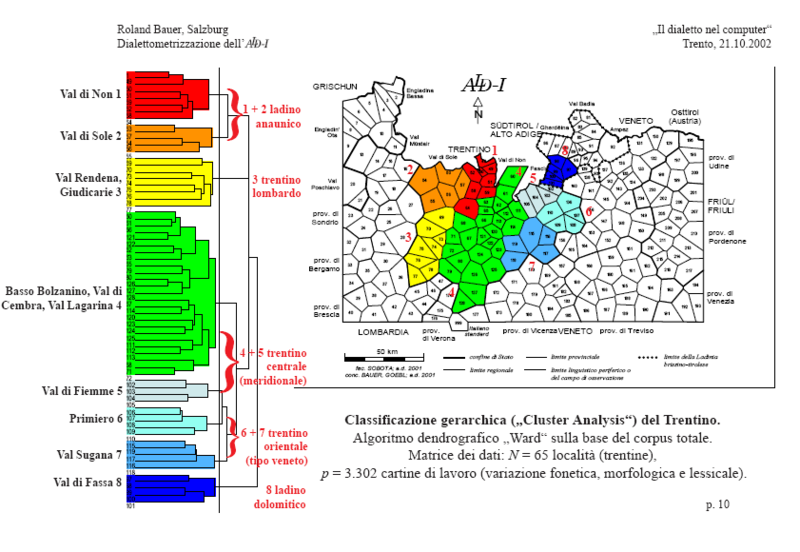
Map of Trentino divided by dialects, from the ALD project curated by Prof. Roland Bauer and Prof. Hans Goebl (University of Salzburg). Licence CC BY-SA 4.0.
The grammatical research
Giving academic grounding to the study, two works:
- the degree thesis of Veronica Bertagnolli (Ca’ Foscari University of Venice, academic year 2007/2008) on the study of Nones as a language and not as a dialect;
- the research of Franziska Maria Hack (University of Oxford), Investigating Interrogation in the Northern Italian Area, or What Corpora Can Tell Us and Which Questions they Leave Open.
The field research of Massimo Paternoster
Massimo Paternoster interviewed people in various places of Trentino, putting a few tasks to them: he had them listen to the audio of a recording, once or more, and asked them to identify the place of that speech. Geographically, the questions were put to inhabitants of all the municipalities of the Val di Non, of five municipalities of the Val di Sole, and to Mezzolombardo, Trento and Pergine.
The most frequent answers were: “Val di Non”, “Val di Sole”, “Vervò”, “Revò”, “Fondo”, “Upper Anaunia”, “Castelfondo”, and statements such as “I’ve still heard this spoken”, “mi chest el conosi”, “chesto l ai sentù amò”, “sto cì me mpar de conoserlo”. After the answer, once the true origin of the speech was revealed (Moena or Pera di Fassa), great was the astonishment, almost a refusal. Only after the explanation of the reason for the interview and the consultation of the documents proving the truth of the recordings did those interviewed accept the truth: that this “Nones” was in reality “Moenat Ladin” and “Brach Ladin”.
At Pergine, the interviewee, after listening to speech from Pera di Fassa, answered: “Fassan”…, immediately after, “no, Fassan is full of gne gni gno gna… no! It isn’t Fassan”…, and after a further moment of thought stated: ”…Nones!”, adding: “Fà na roba, te vai sù en Val de Non e te ghe domandi ai nonesi, te vedrai che el te dise subito…”.
Notes
- Graziadio Isaia Ascoli: linguist and glottologist, senator of the Kingdom of Italy; founder of Rhaeto-Romance dialectology and of the journal Archivio glottologico italiano.
- Giorgio (Johann Georg) Sulzer, from the 1855 work Dell’origine e della natura dei dialetti comunemente chiamati romanici messi a confronto coi dialetti consimili esistenti nel Tirolo.
- Giovan Battista Pellegrini, author of the Carta dei Dialetti d’Italia (1977).
A work of many hands
Fiöi dal Nos was born of the work of the board and members of El Brenz of the time, with the field research and the analysis of the recordings curated by Massimo Paternoster. To all those who, in those two years, gave time, skill and passion goes the recognition of having built something that lasts.
Roots do not freeze
More than a decade on, the questions of Fiöi dal Nos not only remain open: they have found new ways to make themselves heard. Linguistic research continues with the Atlas of Ladin, the memory of the elders will find a home in the Media Library, and the nosa parlada today even has a digital assistant. This documentary remains the point from which everything set out.
Raìs fonde no le ‘nglacia. (Deep roots do not freeze.)
«Fiöi dal Nos. Ladin identity of Val di Non and Val di Sole: culture and language» · documentary by the Associazione Storico Culturale Linguistica El Brenz delle Valli del Noce (2015). Video on the official YouTube channel of El Brenz. The cartographic testimonies cited in the study will be reintroduced on this page as we verify their licences.